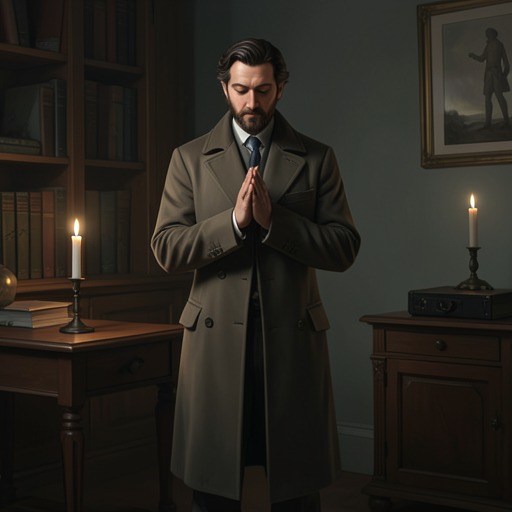
It was not the thorn bending to the honeysuckles, but the honeysuckles embracing the thorn
Wuthering HeightsIt was not the thorn bending to the honeysuckles, but the honeysuckles embracing the thorn is a simile that Ellen Dean, the housekeeper of Thrushcross Grange, uses to describe the early months of Catherine Earnshaw's marriage to Edgar Linton. The image is botanical and precise: the thorn, prickly and erect, does not stoop toward the honeysuckle; instead, the honeysuckle—soft, clinging, and fragrant—wraps itself around the thorn. The figure reverses the expected direction of accommodation, making clear that all the yielding in this union flows one way. Catherine is the thorn, standing upright and unyielding; Edgar and his sister Isabella are the honeysuckles, embracing her with total, self-effacing devotion. Ellen's observation is delivered with the detached clarity of a witness who has seen enough of the world to recognize the shape of a relationship before it curdles, and the simile quietly forecasts the instability of a marriage built on such unequal terms.
The Context of the Simile in Catherine's Marriage
The simile appears in Ellen's retrospective account of the period immediately following Catherine's recovery from her perilous illness and her marriage to Edgar Linton. Ellen had braced herself for the worst, expecting Catherine to behave badly in her new home, but instead found her "almost over-fond" of her husband and even affectionate toward his sister. The two Lintons, for their part, were "very attentive to her comfort." It is at this moment of apparent domestic peace that Ellen reaches for the image of the thorn and the honeysuckles. She notes that there were "no mutual concessions: one stood erect, and the others yielded." The honeysuckles embracing the thorn is not a picture of mutual love but of unilateral surrender, and Ellen adds a practical gloss: "who can be ill-natured and bad-tempered when they encounter neither opposition nor indifference?" Catherine's good behavior, in other words, is not a change of character but a luxury afforded by having her every whim indulged. Edgar, Ellen observes, had "a deep-rooted fear of ruffling her humour," a fear he concealed from Catherine herself but which surfaced whenever a servant answered sharply or grew cloudy at one of her imperious orders. He would show his trouble by a frown of displeasure that never darkened on his own account, and he once averred that "the stab of a knife could not inflict a worse pang" than seeing his lady vexed. For half a year, Ellen concludes, "the gunpowder lay as harmless as sand, because no fire came near to explode it."
The Simile as a Measure of Unequal Love
The honeysuckle-and-thorn figure belongs to a family of images in the novel that measure love by its asymmetry. Where Catherine's own declarations of feeling reach for the permanence of rock and the identity of souls—"I am Heathcliff!" and "My love for Heathcliff resembles the eternal rocks beneath"—Ellen's simile is cooler and more diagnostic. It describes not what Catherine feels but what Edgar and Isabella do: they embrace, they yield, they accommodate. The thorn does not need to bend because the honeysuckles have already wrapped themselves around it. The image thus captures the structural problem at the heart of the marriage: Catherine is loved far more than she loves. Her own account of her feelings for Edgar, given to Ellen before the wedding, is tellingly provisional. She compares her love for Linton to "the foliage in the woods: time will change it, I'm well aware, as winter changes the trees," whereas her love for Heathcliff "resembles the eternal rocks beneath: a source of little visible delight, but necessary." The honeysuckles embracing the thorn is Ellen's way of saying what Catherine will not: that the marriage is a one-sided arrangement in which the Lintons have invested everything and Catherine has invested almost nothing.
The Simile's Place in the Novel's Pattern of Reversal
The image gains its full resonance from the way the novel later reverses it. The honeysuckle that embraces the thorn in the early years of Catherine's marriage is the same Catherine who, in her final confrontation with Heathcliff, accuses him of breaking her heart: "I have not broken your heart—you have broken it; and in breaking it, you have broken mine." The yielding honeysuckle of the Grange becomes, in the end, the broken heart of the woman who thought she could have both men without surrendering herself to either. Ellen's simile also anticipates the novel's larger pattern of domination and submission, in which the roles of thorn and honeysuckle are constantly exchanged. Heathcliff, who arrives at Wuthering Heights as a nameless foundling and is treated as a servant by Hindley Earnshaw, later becomes the mortgagee who holds every yard of Earnshaw land and reduces Hareton to "a state of complete dependence on his father's inveterate enemy." The same Heathcliff who once bent to the will of the Earnshaw household becomes the tyrant who seizes Isabella and thrusts her from the room with the words "I have no pity! I have no pity! The more the worms writhe, the more I yearn to crush out their entrails!" The honeysuckle and the thorn are not fixed identities but positions in a struggle, and the novel shows how easily the one who embraces can become the one who crushes.
The Simile and the Novel's Wider Imagery of Nature
The figure participates in the novel's pervasive use of natural imagery to describe human relationships, but it stands apart from the more violent and elemental images that surround it. Where Heathcliff's grief after Catherine's death erupts in the cry "I cannot live without my life! I cannot live without my soul!" and in the prayer that Catherine "may not rest as long as I am living," Ellen's simile is quiet, almost domestic. It belongs to the register of the garden rather than the moor, of cultivation rather than wilderness. Yet the garden image is no less damning for being gentle. The honeysuckle's embrace is a form of suffocation, and the thorn's erectness is a form of indifference. Ellen's choice of this particular figure suggests that she sees the marriage not as a union of equals but as a kind of horticultural accident, in which the clinging vine has attached itself to the wrong support. The simile thus functions as a quiet warning, buried in the midst of a passage that otherwise celebrates the apparent happiness of the newlyweds. It tells the reader that the peace of Thrushcross Grange is purchased at the price of the Lintons' self-respect, and that a relationship in which one party stands erect while the others yield is not a marriage but a capitulation.
The Simile's Significance in Ellen's Narration
As a piece of Ellen's narration, the simile reveals as much about the speaker as about the subject. Ellen is the novel's great observer of unequal relationships, and her language consistently registers the balance of power in a household with the precision of a seasoned servant who has learned to read the emotional weather of her employers. The honeysuckle-and-thorn figure is characteristic of her style: homely, concrete, and quietly judgmental. It is also characteristic of her position. Ellen stands outside the marriage, close enough to see its dynamics but not so close as to be caught up in them. Her simile is the observation of a woman who has watched Catherine grow from a wild child into a demanding mistress, and who knows that the Lintons' attentiveness is not a sign of strength but of weakness. The image thus carries the authority of long acquaintance and the irony of a servant who understands her masters better than they understand themselves. When Ellen later reports that the marriage "ended when circumstances caused each to feel that the one's interest was not the chief consideration in the other's thoughts," the honeysuckle-and-thorn simile stands behind the diagnosis, explaining why a union that began in such apparent harmony could dissolve so completely. The honeysuckles embraced the thorn, but the thorn never learned to embrace them back.